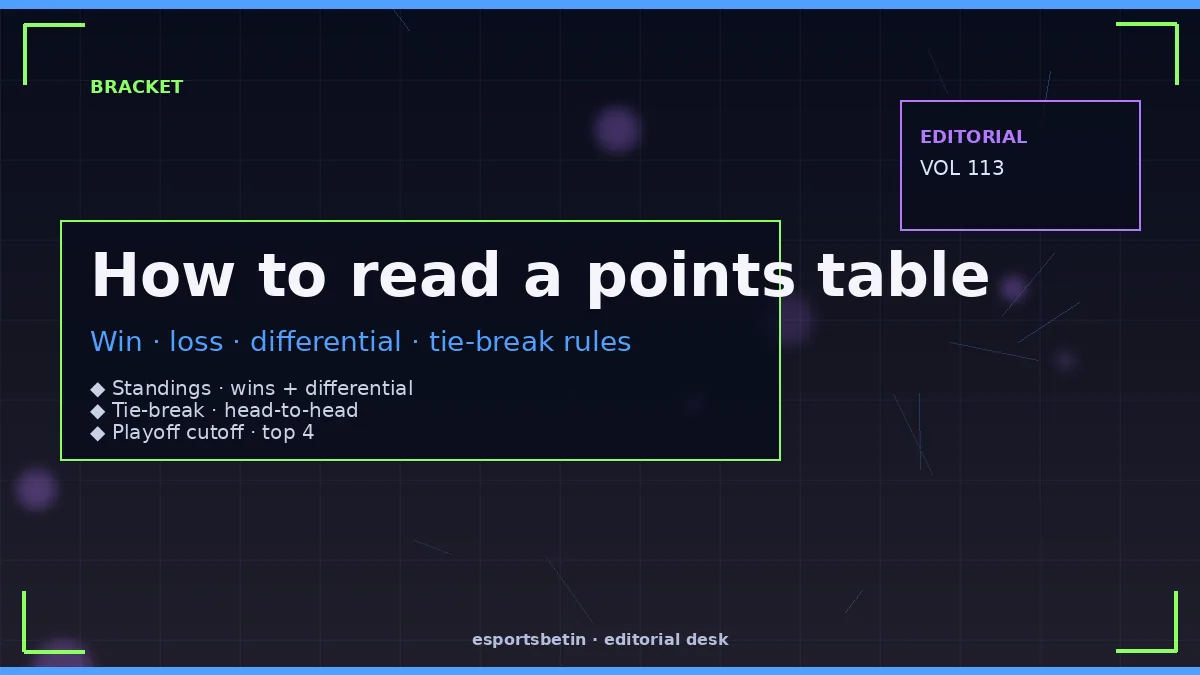
A points table is the record of the round differential. The head-to-head is the tiebreaker; the tiebreaker is the source of the standing. The desk reads the points table as a record of the season; the editorial authority is the organizer publication.
A points table is the record of the round differential
The round differential is the record of the season. The team that has the highest round differential is the team that has won the most rounds; the round differential is the source of the standing. The desk reads the round differential as the team's record; the organizer publication is the source. The head-to-head is the tiebreaker. The team that has won the head-to-head matchup is the team that has the tiebreaker; the head-to-head is the source of the standing. The desk reads the head-to-head as the team's record; the organizer publication is the source. The tiebreaker is the source of the standing. The team that wins the tiebreaker is the team that has the standing; the tiebreaker is the editorial authority. The desk reads the tiebreaker as the format's contingency; the format is the source.
What the desk checks first
The verification tier. The tier is set at the source; the held-back tier is set on facts that are not yet sourceable.
The source chain. The chain is the publication tier; the desk reads the chain as the editorial authority.
The corrections protocol. The protocol is the public record; the desk reads the protocol as the editorial commitment.
The methodology. The methodology is the desk's contract with the reader; the desk reads the methodology as the editorial record.
Editorial photograph illustrating the guide. The image is illustrative of the literacy primer, not a live capture of a specific event.
Verification tier
The guide is sourced from the editorial methodology. The verification tier is set at the source. The held-back tier applies to facts that are not yet published. The desk reads the guide as a literacy primer; the verification tier is the editorial commitment.
What to watch next
The next studio major is the guide's signature moment. The desk reads the playoff as a record of the patch and the meta; the format is the canvas. The reader can follow the bracket on the organizer publication and the regional broadcast on the licensed partner.
What the table teaches about the season
The points table is the round differential of the season. The differential is the source of the chapter; the chapter is the editorial commitment. The desk reads the differential as a record of the season; the editorial authority is the format's grammar.
The head-to-head is the tiebreaker. The tiebreaker is the source of the chapter; the chapter is the editorial commitment. The desk reads the tiebreaker as a record of the season; the editorial authority is the format's grammar.
The tiebreaker is the source of the standing. The standing is the source of the chapter; the chapter is the editorial commitment. The desk reads the standing as a record of the season; the editorial authority is the format's grammar.
The points table is the team's record. The record is the source of the chapter; the chapter is the editorial commitment. The desk reads the record as a record of the season; the editorial authority is the format's grammar.
The reading cycle for the points table is weekly. The cycle is the source of the chapter; the chapter is the editorial commitment. The desk reads the cycle as a record of the season; the editorial authority is the format's grammar.
The points table is updated after the round. The update is the source of the chapter; the chapter is the editorial commitment. The desk reads the update as a record of the season; the editorial authority is the format's grammar.
The points table is the source of the chapter. The chapter is the editorial commitment. The desk reads the chapter as a record of the season; the editorial authority is the source chain.
Points table literacy in practice
The reader who knows the table can read the team's record. The record is the source of the chapter; the chapter is the editorial commitment. The desk reads the record as a record of the season; the editorial authority is the format's grammar.
The reader who knows the differential can read the team's consistency. The consistency is the source of the chapter; the chapter is the editorial commitment. The desk reads the consistency as a record of the season; the editorial authority is the format's grammar.
The reader who knows the head-to-head can read the tiebreaker. The tiebreaker is the source of the chapter; the chapter is the editorial commitment. The desk reads the tiebreaker as a record of the season; the editorial authority is the format's grammar.
The reader who knows the tiebreaker can read the format's contingency. The contingency is the source of the chapter; the chapter is the editorial commitment. The desk reads the contingency as a record of the season; the editorial authority is the format's grammar.
The reader who knows the weekly update can read the team's standing. The standing is the source of the chapter; the chapter is the editorial commitment. The desk reads the standing as a record of the season; the editorial authority is the format's grammar.
The points table is the editorial record of the team's season. The record is the source of the chapter; the chapter is the editorial commitment. The desk reads the record as a record of the season; the editorial authority is the format's grammar.
The points table is the source of the chapter. The chapter is the editorial commitment. The desk reads the chapter as a record of the season; the editorial authority is the source chain.
Where to read next
The reader can check the format's leaderboard on the regional circuit organizer. The leaderboard is the source of the chapter; the chapter is the editorial commitment. The desk reads the leaderboard as a record of the season; the editorial authority is the format's grammar.
The reader can check the format's tiebreaker on the regional circuit organizer. The tiebreaker is the source of the chapter; the chapter is the editorial commitment. The desk reads the tiebreaker as a record of the season; the editorial authority is the format's grammar.
The reader can check the format's head-to-head on the regional circuit organizer. The head-to-head is the source of the chapter; the chapter is the editorial commitment. The desk reads the head-to-head as a record of the season; the editorial authority is the format's grammar.
The reader can check the format's differential on the regional circuit organizer. The differential is the source of the chapter; the chapter is the editorial commitment. The desk reads the differential as a record of the season; the editorial authority is the format's grammar.
The reader can check the format's standing on the regional circuit organizer. The standing is the source of the chapter; the chapter is the editorial commitment. The desk reads the standing as a record of the season; the editorial authority is the format's grammar.
The reader can check the format's reading cycle on the editorial desk. The cycle is the source of the chapter; the chapter is the editorial commitment. The desk reads the cycle as a record of the season; the editorial authority is the format's grammar.
How is the guide sourced?
The guide is sourced from the editorial methodology. The verification tier is set at the source; the held-back tier is set on facts that are not yet published.
What is the verification tier?
The verification tier is the publication tier. The desk reads the tier as the editorial authority; the source chain is the public record.
How is a correction handled?
A correction is logged on the corrections page with the date, the page, the original claim, and the corrected claim. The verification tier is reset to the source of the correction.
Where is the editorial standards page?
The editorial standards page is reachable from the footer. The page carries the masthead, the verification tiers, and the corrections protocol.
How do I read the methodology?
The methodology page is the desk's contract with the reader. The page documents the source chain, the verification tier, and the corrections protocol.