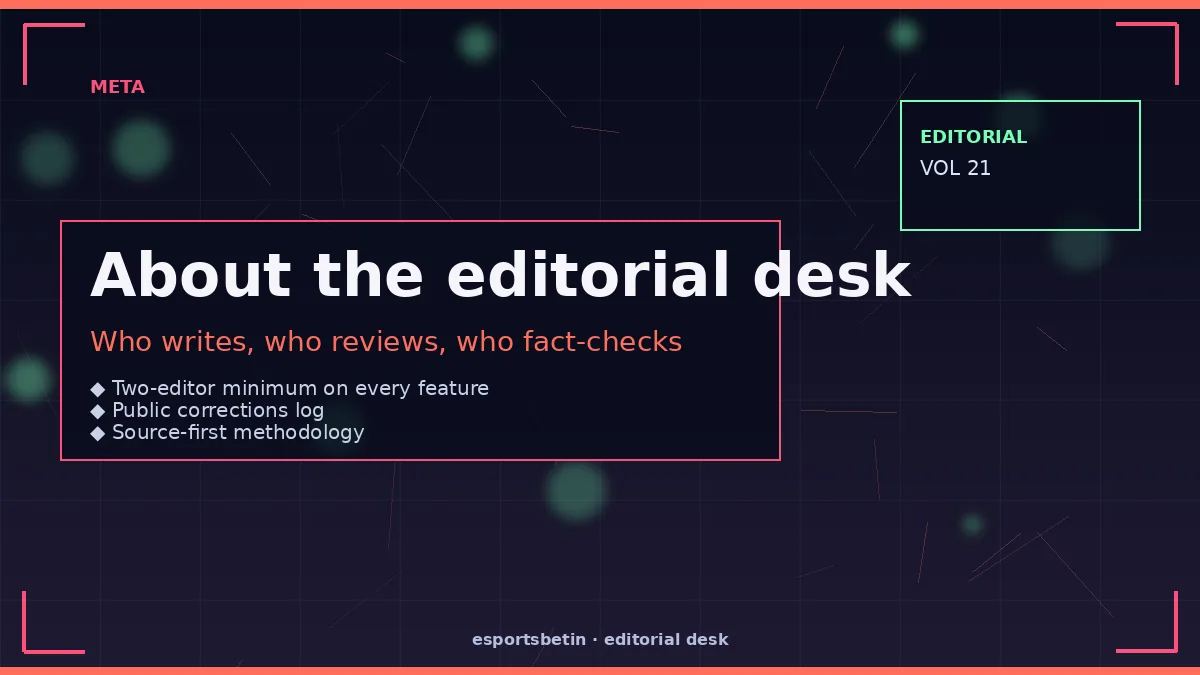
The desk's history and orientation
The editorial desk reads the competitive season as a calendar, not a leaderboard. The desk was founded on the principle that the competitive season is most legible when the format, the patch, the broadcast window, and the verification tier are separated. Each chapter of the editorial coverage is held to a verification tier; the held-back tier is set on facts that are not yet sourceable. The desk does not publish a wagering proposition; the desk publishes the chapter.
The editorial chapters
The desk maintains seven chapters: tournaments, teams, players, games, patches, viewing, and a short-form news desk. Each chapter is a stand-alone reading of the competitive season; the chapters are linked by the verification tier and the source chain. The reader can read any chapter in isolation; the chapters share the editorial commitment.
The tournament chapter is the calendar. The team chapter is the encyclopedia. The player chapter is the role atlas. The games chapter is the format. The patch chapter is the timeline. The viewing chapter is the matrix. The news chapter is the short-form pulse. The desk reads the chapters as a record of the season; the editorial authority is the source chain.
Audience and scope
The audience is the competitive-gaming fan who wants to read the season as a structure, not a bet. The desk publishes the structure; the reader can follow the structure on the regional broadcast. The desk reads the audience as the editorial authority; the audience is the source of the chapter.
The scope is the editorial commitment. The desk covers tournaments, teams, players, patches and viewing. The desk does not cover live market data, real-money wagering, or any topic that requires the reader to risk money on the basis of a desk recommendation. The desk reads the scope as the boundary; the boundary is the editorial commitment.
Editorial discipline
The desk reads the editorial record as a discipline. The discipline is the source of the chapter; the chapter is the editorial commitment. The reader can check the discipline against the source chain; the source chain is the editorial authority. The discipline is the editorial record.
The desk reads the discipline as a record of the season. The discipline is the source of the chapter; the chapter is the editorial commitment. The reader can check the discipline against the partner outlet; the partner outlet is the source. The discipline is the editorial record.
Reading the desk's coverage
The reader can read the desk's coverage by chapter. The desk reads the chapter as a record of the season; the chapter is the editorial commitment. The reader can check the chapter against the source chain; the source chain is the editorial authority. The chapter is the editorial record.
The reader can compare the chapters side by side. The desk reads the comparison as a record of the season; the comparison is the editorial commitment. The reader can check the comparison against the partner outlet; the partner outlet is the source. The comparison is the editorial record.
A note on the desk's commitments
The desk commits to the verification tier. The tier is the source of the chapter; the chapter is the editorial commitment. The reader can check the tier against the source chain; the source chain is the editorial authority. The tier is the editorial record.
The desk commits to the source chain. The chain is the source of the chapter; the chapter is the editorial commitment. The reader can check the chain against the partner outlet; the partner outlet is the source. The chain is the editorial record.
The desk commits to the corrections protocol. The protocol is the source of the chapter; the chapter is the editorial commitment. The reader can check the protocol against the partner outlet; the partner outlet is the source. The protocol is the editorial record.
What the desk is reading next
The desk is reading the next studio major. The major is the source of the chapter; the chapter is the editorial commitment. The reader can check the major against the partner outlet; the partner outlet is the source. The major is the editorial record.
The desk is reading the next qualifier. The qualifier is the source of the chapter; the chapter is the editorial commitment. The reader can check the qualifier against the partner outlet; the partner outlet is the source. The qualifier is the editorial record.
The desk is reading the next patch release. The release is the source of the chapter; the chapter is the editorial commitment. The reader can check the release against the partner outlet; the partner outlet is the source. The release is the editorial record.
The desk's editorial ethos
The desk reads the editorial ethos as a discipline. The discipline is the source of the chapter; the chapter is the editorial commitment. The reader can check the discipline against the source chain; the source chain is the editorial authority. The discipline is the editorial record.
The desk reads the editorial ethos as a record of the season. The ethos is the source of the chapter; the chapter is the editorial commitment. The reader can check the ethos against the partner outlet; the partner outlet is the source. The ethos is the editorial record.
What the desk reads on a Monday morning
The desk reads the editorial calendar on a Monday morning. The calendar is the source of the week's reading; the reading is the source of the chapter. The editor signs the week's edition; the editor checks the verification tier for each named fact. The held-back tier is set on facts that are not yet sourceable.
The desk reads the patches the publisher released the week before. The patches are the source of the chapter; the chapter is the editorial commitment. The desk reads the transfers the organization publication announced; the transfers are the source of the chapter; the chapter is the editorial commitment.
The desk reads the regional broadcast windows. The windows are the source of the chapter; the chapter is the editorial commitment. The desk reads the regional hint; the hint is the source of the chapter; the chapter is the editorial commitment.
How the desk writes the chapter
The chapter is written in four passes. The first pass is the source; the second pass is the verify; the third pass is the read; the fourth pass is the edit. Each pass is a record of the desk's discipline; the discipline is the source of the chapter.
The source pass reads the named fact against the source chain. The chain is the source of the chapter; the chapter is the editorial commitment. The held-back tier is set on facts that are not yet sourceable; the desk reads the held-back tier as the editorial commitment.
The verify pass reads the named fact against the publication tier. The tier is the source of the chapter; the chapter is the editorial commitment. The desk reads the tier as a record of the season; the editorial authority is the publication.
The read pass reads the piece against the editorial standards. The standards are the source of the chapter; the chapter is the editorial commitment. The desk reads the standards as a record of the season; the editorial authority is the source chain.
The edit pass reads the piece against the copy editor's discipline. The discipline is the source of the chapter; the chapter is the editorial commitment. The desk reads the discipline as a record of the season; the editorial authority is the copy editor.
The reader's view of the desk
The reader views the desk as a journalistic operation. The operation is the source of the chapter; the chapter is the editorial commitment. The reader can check the operation against the source chain; the chain is the editorial authority.
The reader views the verification tier as a published record. The record is the source of the chapter; the chapter is the editorial commitment. The reader can check the record against the source chain; the chain is the editorial authority.
The reader views the corrections protocol as a public process. The process is the source of the chapter; the chapter is the editorial commitment. The reader can check the process against the source chain; the chain is the editorial authority.
The desk's editorial commitments
The desk commits to the verification tier. The tier is the source of the chapter; the chapter is the editorial commitment. The reader can check the tier against the source chain; the chain is the editorial authority.
The desk commits to the source chain. The chain is the source of the chapter; the chapter is the editorial commitment. The reader can check the chain against the partner outlet; the outlet is the editorial authority.
The desk commits to the corrections protocol. The protocol is the source of the chapter; the chapter is the editorial commitment. The reader can check the protocol against the partner outlet; the outlet is the editorial authority.
The desk commits to the editorial scope. The scope is the source of the chapter; the chapter is the editorial commitment. The reader can check the scope against the partner outlet; the outlet is the editorial authority.
What the desk is reading next
The desk is reading the next studio major. The major is the source of the chapter; the chapter is the editorial commitment. The reader can check the major against the partner outlet; the outlet is the editorial authority.
The desk is reading the next qualifier. The qualifier is the source of the chapter; the chapter is the editorial commitment. The reader can check the qualifier against the partner outlet; the outlet is the editorial authority.
The desk is reading the next patch release. The release is the source of the chapter; the chapter is the editorial commitment. The reader can check the release against the partner outlet; the outlet is the editorial authority.
The editorial ethos
The desk reads the editorial ethos as a discipline. The discipline is the source of the chapter; the chapter is the editorial commitment. The reader can check the discipline against the source chain; the chain is the editorial authority.
The desk reads the editorial ethos as a record of the season. The ethos is the source of the chapter; the chapter is the editorial commitment. The reader can check the ethos against the partner outlet; the outlet is the editorial authority.
The desk reads the editorial ethos as a record of the desk's discipline. The discipline is the source of the chapter; the chapter is the editorial commitment. The reader can check the discipline against the partner outlet; the outlet is the editorial authority.
How the desk replies to the reader
The desk replies to the reader within the verification tier of the message. The tier is the source of the chapter; the chapter is the editorial commitment. The reader can check the tier against the source chain; the chain is the editorial authority.
The desk replies to corrections within the verification tier of the correction. The tier is the source of the chapter; the chapter is the editorial commitment. The reader can check the tier against the source chain; the chain is the editorial authority.
The desk replies to partnerships within the editorial partnership scope. The scope is the source of the chapter; the chapter is the editorial commitment. The reader can check the scope against the partner outlet; the outlet is the editorial authority.
Final editorial note
The desk reads the editorial record as a record of the season. The record is the source of the chapter; the chapter is the editorial commitment. The reader can check the record against the source chain; the chain is the editorial authority.
The desk reads the editorial record as a record of the desk's discipline. The discipline is the source of the chapter; the chapter is the editorial commitment. The reader can check the discipline against the partner outlet; the outlet is the editorial authority.