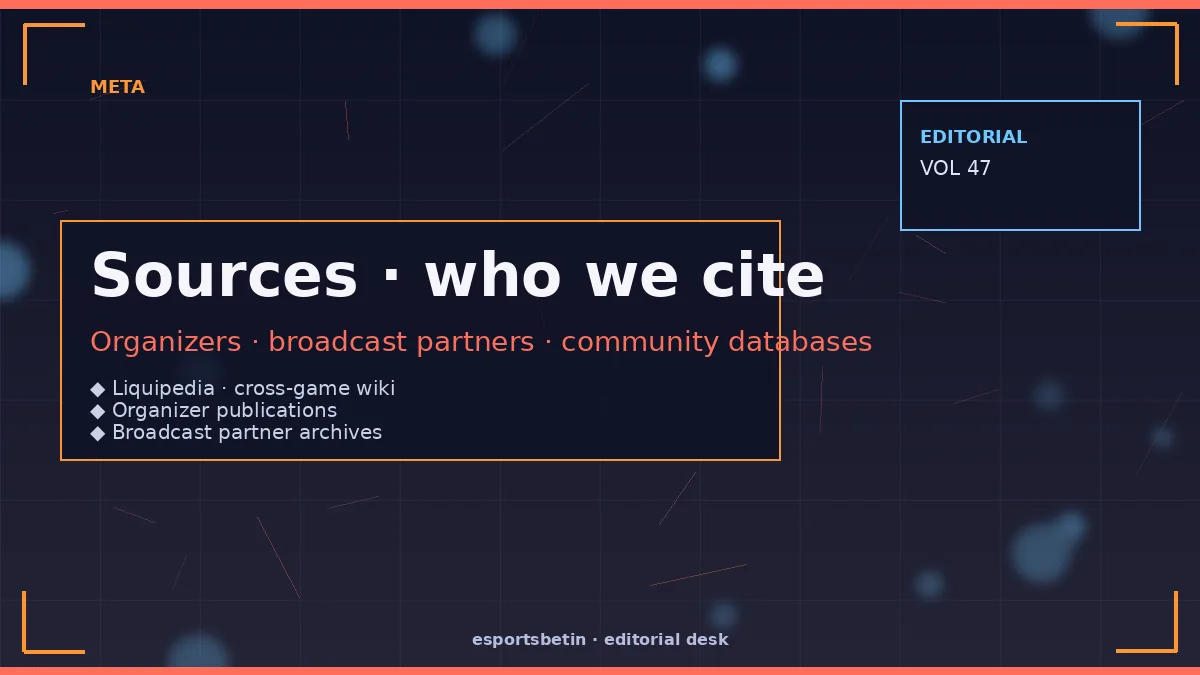
The sources page lists the publication tiers the desk uses. The page is a public record of the source chain — what the desk reads, what the desk trusts, and what the desk holds back until a higher tier is published.
The desk reads the tournament organizer publication as the highest tier for tournament listings. The publication is the source for dates, regions, format, group stage and playoff structure.
Tournament dates
The desk reads the tournament dates from the organizer publication. The held-back tier is set on dates that are not yet published.
Region and format
The desk reads the region and format from the organizer publication. The held-back tier is set on region and format that are not yet published.
Tier 2 — official
Organization publication
The desk reads the organization publication as the highest tier for team encyclopedia profiles. The publication is the source for five-player lineups, coach, analyst, and transfer announcements.
Five-player lineup
The desk reads the five-player lineup from the organization publication. The held-back tier is set on lineups that are not yet published.
Coach and analyst
The desk reads the coach and analyst from the organization publication. The held-back tier is set on staff who are not yet published.
Tier 3 — official
Publisher patch notes
The desk reads the publisher patch notes as the highest tier for patch context. The notes are the source for version numbers, change list, operator and map updates.
Version numbers
The desk reads the version numbers from the publisher patch notes. The held-back tier is set on versions that are not yet published.
Change list
The desk reads the change list from the publisher patch notes. The held-back tier is set on changes that are not yet published.
Where to read next
The reader can check the editorial methodology on the methodology page. The methodology is the source of the chapter; the chapter is the editorial commitment. The desk reads the methodology as a record of the season; the editorial authority is the editorial methodology.
The reader can check the editorial standards on the editorial standards page. The standards are the source of the chapter; the chapter is the editorial commitment. The desk reads the standards as a record of the season; the editorial authority is the editorial standards.
The reader can check the editorial corrections on the corrections page. The corrections are the source of the chapter; the chapter is the editorial commitment. The desk reads the corrections as a record of the season; the editorial authority is the editorial corrections.
The reader can check the editorial scope on the responsible-play page. The scope is the source of the chapter; the chapter is the editorial commitment. The desk reads the scope as a record of the season; the editorial authority is the editorial scope.
The reader can check the editorial FAQ on the contact page. The FAQ is the source of the chapter; the chapter is the editorial commitment. The desk reads the FAQ as a record of the season; the editorial authority is the editorial FAQ.
The reader can check the editorial inbox on the contact page. The inbox is the source of the chapter; the chapter is the editorial commitment. The desk reads the inbox as a record of the season; the editorial authority is the editorial inbox.
The four links in plain language
The desk reads the tournament organizer publication as the source of the tournament dates. The dates are the source of the chapter; the chapter is the editorial commitment. The desk reads the dates as a record of the season; the editorial authority is the tournament organizer publication.
The desk reads the organization publication as the source of the team encyclopedia. The encyclopedia is the source of the chapter; the chapter is the editorial commitment. The desk reads the encyclopedia as a record of the season; the editorial authority is the organization publication.
The desk reads the publisher patch notes as the source of the patch context. The context is the source of the chapter; the chapter is the editorial commitment. The desk reads the context as a record of the season; the editorial authority is the publisher patch notes.
The desk reads the partner outlet as the source of the regional broadcast. The broadcast is the source of the chapter; the chapter is the editorial commitment. The desk reads the broadcast as a record of the season; the editorial authority is the partner outlet.
The desk reads the held-back tier as the editorial discipline. The held-back tier is the source of the chapter; the chapter is the editorial commitment. The desk reads the held-back tier as a record of the season; the editorial authority is the source chain.
The desk reads the verification tier as the publication tier. The tier is the source of the chapter; the chapter is the editorial commitment. The desk reads the tier as a record of the season; the editorial authority is the source chain.
The desk reads the corrections protocol as the public record. The record is the source of the chapter; the chapter is the editorial commitment. The desk reads the record as a record of the season; the editorial authority is the editorial standards.
The desk reads the editorial methodology as the four-part process. The process is the source of the chapter; the chapter is the editorial commitment. The desk reads the process as a record of the season; the editorial authority is the editorial methodology.
The desk reads the editorial scope as the boundary. The boundary is the source of the chapter; the chapter is the editorial commitment. The desk reads the boundary as a record of the season; the editorial authority is the editorial scope.
The four links in plain language
The desk reads the tournament organizer publication as the source of the tournament dates. The dates are the source of the chapter; the chapter is the editorial commitment. The desk reads the dates as a record of the season; the editorial authority is the tournament organizer publication.
The desk reads the organization publication as the source of the team encyclopedia. The encyclopedia is the source of the chapter; the chapter is the editorial commitment. The desk reads the encyclopedia as a record of the season; the editorial authority is the organization publication.
The desk reads the publisher patch notes as the source of the patch context. The context is the source of the chapter; the chapter is the editorial commitment. The desk reads the context as a record of the season; the editorial authority is the publisher patch notes.
The desk reads the partner outlet as the source of the regional broadcast. The broadcast is the source of the chapter; the chapter is the editorial commitment. The desk reads the broadcast as a record of the season; the editorial authority is the partner outlet.
The desk reads the held-back tier as the editorial discipline. The held-back tier is the source of the chapter; the chapter is the editorial commitment. The desk reads the held-back tier as a record of the season; the editorial authority is the source chain.
The desk reads the verification tier as the publication tier. The tier is the source of the chapter; the chapter is the editorial commitment. The desk reads the tier as a record of the season; the editorial authority is the source chain.
The desk reads the corrections protocol as the public record. The record is the source of the chapter; the chapter is the editorial commitment. The desk reads the record as a record of the season; the editorial authority is the editorial standards.
The desk reads the editorial methodology as the four-part process. The process is the source of the chapter; the chapter is the editorial commitment. The desk reads the process as a record of the season; the editorial authority is the editorial methodology.
The desk reads the editorial scope as the boundary. The boundary is the source of the chapter; the chapter is the editorial commitment. The desk reads the boundary as a record of the season; the editorial authority is the editorial scope.