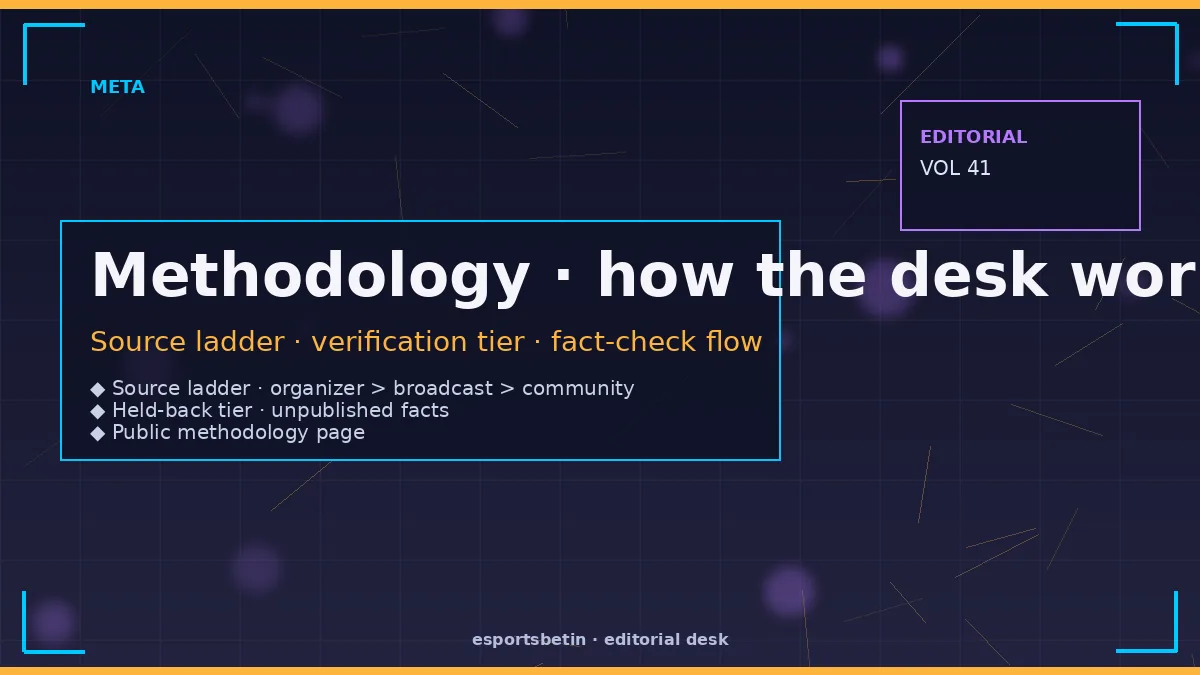
The methodology page documents the editorial process. How a tournament enters the horizon, how a roster is confirmed, how a patch is read, how a correction is logged. The page is the desk's contract with the reader.
The desk reads the season through five links. Each link is a verification tier. The fifth link is the held-back tier for facts that are not yet sourceable.
Link 1Tournament organizer publicationType: official
Link 2Organization publicationType: official
Link 3Publisher patch notesType: official
Link 4Partner outletType: verified third party
Link 5Held backType: held until link 1–4 is published
The four-part process
How a piece ends up on the page
The desk publishes a piece when the four-part process is complete. The piece is then read against the editorial standards and copy edited before publication.
1 · Source
The desk reads the named fact against the source chain. The verification tier is set at the source.
2 · Verify
The named fact is verified against the publication tier. The held-back tier is set on facts that are not yet sourceable.
3 · Read
The piece is read against the editorial standards: the verification tier, the source chain, the held-back tier, and the corrections protocol.
4 · Edit
The piece is copy edited. The desk checks the verification tier, the source chain, and the held-back tier before publication.
What's next for the desk
The reader can check the editorial sources on the sources page. The sources are the source of the chapter; the chapter is the editorial commitment. The desk reads the sources as a record of the season; the editorial authority is the editorial sources.
The reader can check the editorial standards on the editorial standards page. The standards are the source of the chapter; the chapter is the editorial commitment. The desk reads the standards as a record of the season; the editorial authority is the editorial standards.
The reader can check the editorial corrections on the corrections page. The corrections are the source of the chapter; the chapter is the editorial commitment. The desk reads the corrections as a record of the season; the editorial authority is the editorial corrections.
The reader can check the editorial scope on the responsible-play page. The scope is the source of the chapter; the chapter is the editorial commitment. The desk reads the scope as a record of the season; the editorial authority is the editorial scope.
The reader can check the editorial FAQ on the contact page. The FAQ is the source of the chapter; the chapter is the editorial commitment. The desk reads the FAQ as a record of the season; the editorial authority is the editorial FAQ.
The reader can check the editorial inbox on the contact page. The inbox is the source of the chapter; the chapter is the editorial commitment. The desk reads the inbox as a record of the season; the editorial authority is the editorial inbox.
How the desk reads the methodology
The desk reads the source as the first step. The source is the source of the chapter; the chapter is the editorial commitment. The desk reads the source as a record of the season; the editorial authority is the source chain.
The desk reads the verify as the second step. The verify is the source of the chapter; the chapter is the editorial commitment. The desk reads the verify as a record of the season; the editorial authority is the source chain.
The desk reads the read as the third step. The read is the source of the chapter; the chapter is the editorial commitment. The desk reads the read as a record of the season; the editorial authority is the source chain.
The desk reads the edit as the fourth step. The edit is the source of the chapter; the chapter is the editorial commitment. The desk reads the edit as a record of the season; the editorial authority is the source chain.
The desk reads the verification tier as the publication tier. The tier is the source of the chapter; the chapter is the editorial commitment. The desk reads the tier as a record of the season; the editorial authority is the source chain.
The desk reads the source chain as the public record. The chain is the source of the chapter; the chapter is the editorial commitment. The desk reads the chain as a record of the season; the editorial authority is the source chain.
The desk reads the held-back tier as the editorial discipline. The held-back tier is the source of the chapter; the chapter is the editorial commitment. The desk reads the held-back tier as a record of the season; the editorial authority is the source chain.
The desk reads the corrections protocol as the public record. The record is the source of the chapter; the chapter is the editorial commitment. The desk reads the record as a record of the season; the editorial authority is the editorial standards.
The desk reads the editorial scope as the boundary. The boundary is the source of the chapter; the chapter is the editorial commitment. The desk reads the boundary as a record of the season; the editorial authority is the editorial scope.
The source-and-read cycle in practice
The desk reads the source as the first step. The source is the source of the chapter; the chapter is the editorial commitment. The desk reads the source as a record of the season; the editorial authority is the source chain.
The desk reads the named fact against the source chain. The fact is the source of the chapter; the chapter is the editorial commitment. The desk reads the fact as a record of the season; the editorial authority is the source chain.
The desk reads the verification tier as the publication tier. The tier is the source of the chapter; the chapter is the editorial commitment. The desk reads the tier as a record of the season; the editorial authority is the source chain.
The desk reads the held-back tier as the editorial discipline. The held-back tier is the source of the chapter; the chapter is the editorial commitment. The desk reads the held-back tier as a record of the season; the editorial authority is the source chain.
The desk reads the verify as the second step. The verify is the source of the chapter; the chapter is the editorial commitment. The desk reads the verify as a record of the season; the editorial authority is the source chain.
The desk reads the read as the third step. The read is the source of the chapter; the chapter is the editorial commitment. The desk reads the read as a record of the season; the editorial authority is the source chain.
The desk reads the edit as the fourth step. The edit is the source of the chapter; the chapter is the editorial commitment. The desk reads the edit as a record of the season; the editorial authority is the source chain.
The desk reads the corrections protocol as the public record. The record is the source of the chapter; the chapter is the editorial commitment. The desk reads the record as a record of the season; the editorial authority is the editorial standards.
The desk reads the editorial scope as the boundary. The boundary is the source of the chapter; the chapter is the editorial commitment. The desk reads the boundary as a record of the season; the editorial authority is the editorial scope.