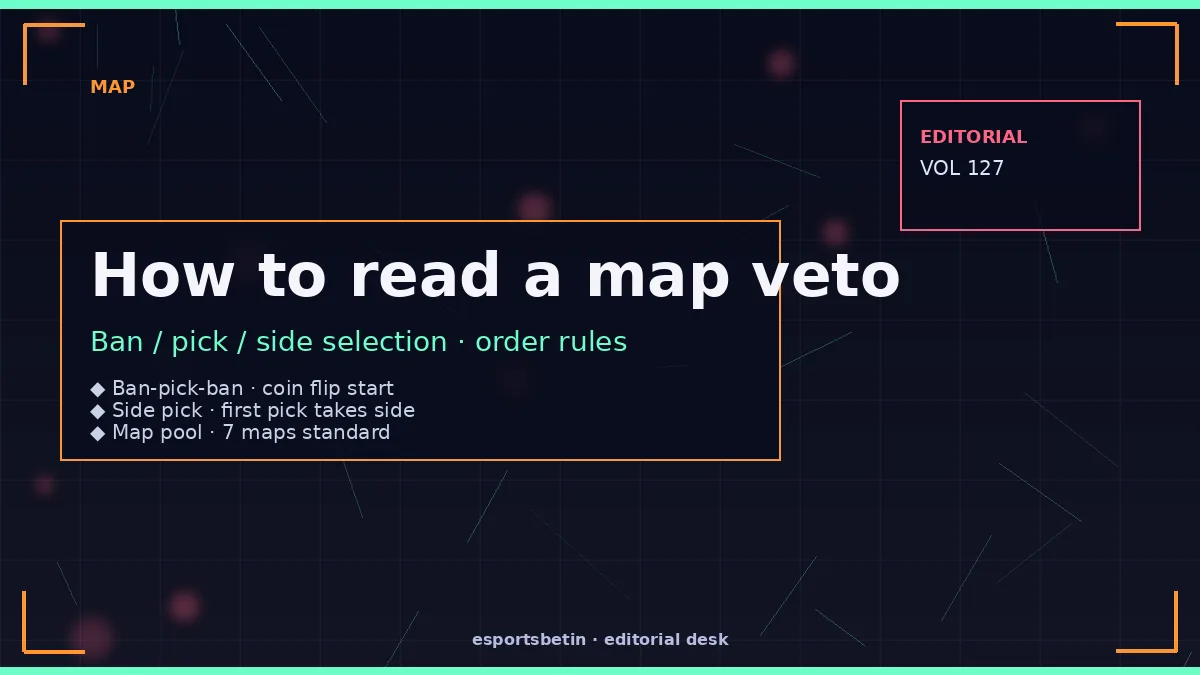
Guide · Map veto · Veto order, side selection, decider
How to read a map veto
A map veto is the team's first cut on the round. The veto order is the sequence of bans and picks; the side selection is the round-to-half bet; the decider map is the seventh map in a best-of-seven series. The desk reads the veto as a record of the team's preparation.
The veto order is the sequence of bans and picks. The team bans the maps that the opponent would otherwise play; the team picks the maps that the team is willing to play. The veto order is the source of the map pool; the desk reads the order as a record of the team's preparation. The side selection is the round-to-half bet. The team selects the side that the team is willing to play first; the side selection is the source of the half. The desk reads the side selection as the team's preparation; the format is the source. The trade is the side the team is willing to give up for the half. The decider map is the seventh map in a best-of-seven series. The decider is the map that the format produces when the veto sequence is exhausted; the decider is the source of the format. The desk reads the decider as the format's contingency; the organizer publication is the source.
What the desk checks first
The verification tier. The tier is set at the source; the held-back tier is set on facts that are not yet sourceable.
The source chain. The chain is the publication tier; the desk reads the chain as the editorial authority.
The corrections protocol. The protocol is the public record; the desk reads the protocol as the editorial commitment.
The methodology. The methodology is the desk's contract with the reader; the desk reads the methodology as the editorial record.
Editorial photograph illustrating the guide. The image is illustrative of the literacy primer, not a live capture of a specific event.
Verification tier
The guide is sourced from the editorial methodology. The verification tier is set at the source. The held-back tier applies to facts that are not yet published. The desk reads the guide as a literacy primer; the verification tier is the editorial commitment.
What to watch next
The next studio major is the guide's signature moment. The desk reads the playoff as a record of the patch and the meta; the format is the canvas. The reader can follow the bracket on the organizer publication and the regional broadcast on the licensed partner.
What the veto teaches about the format
The veto is the team's first cut on the round. The cut is the source of the chapter; the chapter is the editorial commitment. The desk reads the cut as a record of the season; the editorial authority is the format's grammar.
The veto order is the sequence of bans and picks. The sequence is the source of the chapter; the chapter is the editorial commitment. The desk reads the sequence as a record of the season; the editorial authority is the team's preparation.
The side selection is the round-to-half bet. The bet is the source of the chapter; the chapter is the editorial commitment. The desk reads the bet as a record of the season; the editorial authority is the format's grammar.
The decider map is the seventh map in a best-of-seven series. The decider is the source of the chapter; the chapter is the editorial commitment. The desk reads the decider as a record of the season; the editorial authority is the format's grammar.
The trade is the side the team is willing to give up. The trade is the source of the chapter; the chapter is the editorial commitment. The desk reads the trade as a record of the season; the editorial authority is the format's grammar.
The map pool is the team's first cut on the veto. The cut is the source of the chapter; the chapter is the editorial commitment. The desk reads the cut as a record of the season; the editorial authority is the team's preparation.
The veto is the round's first decision. The decision is the source of the chapter; the chapter is the editorial commitment. The desk reads the decision as a record of the season; the editorial authority is the team encyclopedia.
The veto is the source of the chapter. The chapter is the editorial commitment. The desk reads the chapter as a record of the season; the editorial authority is the source chain.
Veto literacy in practice
The reader who knows the veto can read the team's first cut. The cut is the source of the chapter; the chapter is the editorial commitment. The desk reads the cut as a record of the season; the editorial authority is the team's preparation.
The reader who knows the order can read the team's preparation. The preparation is the source of the chapter; the chapter is the editorial commitment. The desk reads the preparation as a record of the season; the editorial authority is the team's preparation.
The reader who knows the side selection can read the round-to-half bet. The bet is the source of the chapter; the chapter is the editorial commitment. The desk reads the bet as a record of the season; the editorial authority is the format's grammar.
The reader who knows the decider can read the format's contingency. The contingency is the source of the chapter; the chapter is the editorial commitment. The desk reads the contingency as a record of the season; the editorial authority is the format's grammar.
The reader who knows the trade can read the team's side cost. The cost is the source of the chapter; the chapter is the editorial commitment. The desk reads the cost as a record of the season; the editorial authority is the format's grammar.
The veto is the editorial record of the team's first cut. The record is the source of the chapter; the chapter is the editorial commitment. The desk reads the record as a record of the season; the editorial authority is the team's preparation.
The veto is the source of the chapter. The chapter is the editorial commitment. The desk reads the chapter as a record of the season; the editorial authority is the source chain.
How is the guide sourced?
The guide is sourced from the editorial methodology. The verification tier is set at the source; the held-back tier is set on facts that are not yet published.
What is the verification tier?
The verification tier is the publication tier. The desk reads the tier as the editorial authority; the source chain is the public record.
How is a correction handled?
A correction is logged on the corrections page with the date, the page, the original claim, and the corrected claim. The verification tier is reset to the source of the correction.
Where is the editorial standards page?
The editorial standards page is reachable from the footer. The page carries the masthead, the verification tiers, and the corrections protocol.
How do I read the methodology?
The methodology page is the desk's contract with the reader. The page documents the source chain, the verification tier, and the corrections protocol.