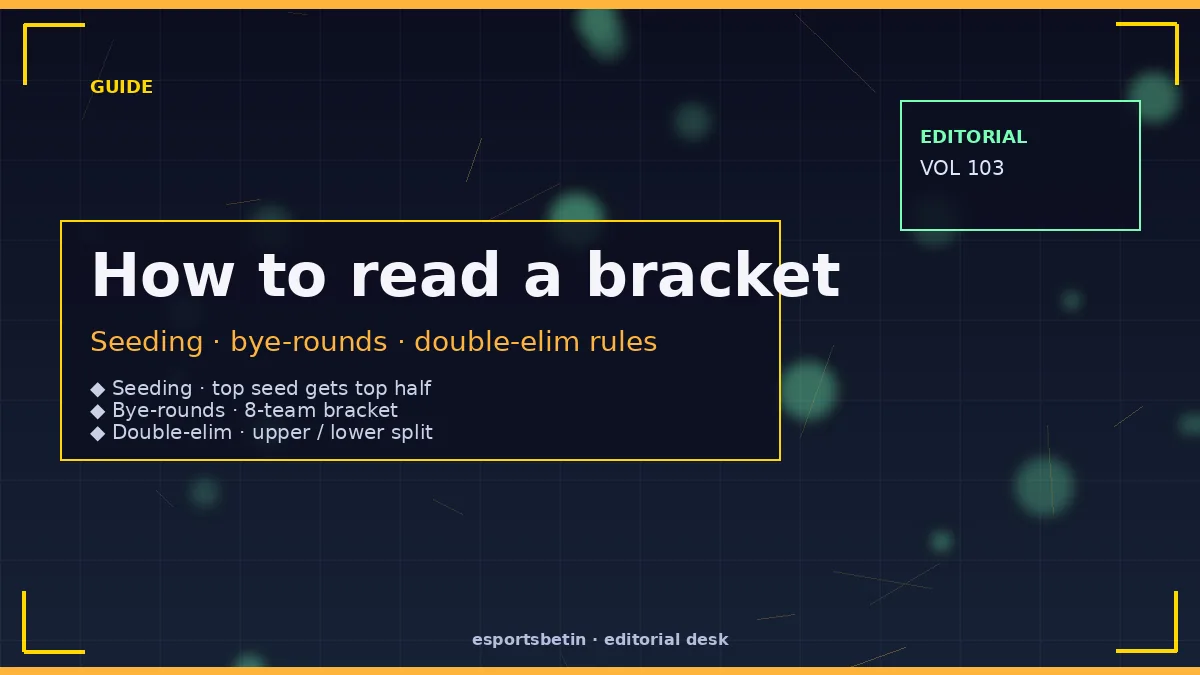
A bracket is a procedural statement. The four formats the editorial desk covers — single-elimination, double-elimination, GSL, Swiss — each carry a specific calendar. The reader who knows the format can predict the calendar.
A single-elimination bracket ends with one loss. The format is the simplest of the four formats the desk covers; the calendar is the shortest. The team's first decision is the seeding; the second decision is the path. The path is the source of the bracket; the team that emerges from the bracket has, by the end, the most complete picture of the patch and the meta. A double-elimination bracket has an upper bracket and a lower bracket, with the grand final reset. The format rewards consistency and surfaces second chances; the second chance is the structural feature the format is built around. The team's first decision is the upper bracket placement; the second decision is the lower bracket path. A GSL bracket is two groups of four, with double-elimination within each group. The top two from each group meet in the semifinals; the format is named for the group stage principle. The format rewards head-to-head study; the second group day is the most informative moment. A Swiss bracket is three rounds per day, matched by wins and losses. The format rewards depth; a team that loses two rounds is eliminated, and a team that wins two rounds advances. The format is the most common lead-in to a playoff bracket.
What the desk checks first
The verification tier. The tier is set at the source; the held-back tier is set on facts that are not yet sourceable.
The source chain. The chain is the publication tier; the desk reads the chain as the editorial authority.
The corrections protocol. The protocol is the public record; the desk reads the protocol as the editorial commitment.
The methodology. The methodology is the desk's contract with the reader; the desk reads the methodology as the editorial record.
Editorial photograph illustrating the guide. The image is illustrative of the literacy primer, not a live capture of a specific event.
Verification tier
The guide is sourced from the editorial methodology. The verification tier is set at the source. The held-back tier applies to facts that are not yet published. The desk reads the guide as a literacy primer; the verification tier is the editorial commitment.
What to watch next
The next studio major is the guide's signature moment. The desk reads the playoff as a record of the patch and the meta; the format is the canvas. The reader can follow the bracket on the organizer publication and the regional broadcast on the licensed partner.
What the bracket teaches about the calendar
The bracket is the procedural statement of how the format resolves the field. The procedural statement is the source of the chapter; the chapter is the editorial commitment. The desk reads the procedural statement as a record of the season; the editorial authority is the format's grammar.
The single elimination bracket ends with one loss. The loss is the source of the chapter; the chapter is the editorial commitment. The desk reads the loss as a record of the season; the editorial authority is the format's grammar.
The double elimination bracket has an upper bracket and a lower bracket. The brackets are the source of the chapter; the chapter is the editorial commitment. The desk reads the brackets as a record of the season; the editorial authority is the format's grammar.
The GSL bracket is two groups of four. The groups are the source of the chapter; the chapter is the editorial commitment. The desk reads the groups as a record of the season; the editorial authority is the format's grammar.
The Swiss bracket is three rounds per day. The rounds are the source of the chapter; the chapter is the editorial commitment. The desk reads the rounds as a record of the season; the editorial authority is the format's grammar.
The bracket fragment is illustrative. The fragment is the source of the chapter; the chapter is the editorial commitment. The desk reads the fragment as a record of the season; the editorial authority is the format's grammar.
The bracket is the calendar. The calendar is the source of the chapter; the chapter is the editorial commitment. The desk reads the calendar as a record of the season; the editorial authority is the format's grammar.
The bracket is the editorial record. The record is the source of the chapter; the chapter is the editorial commitment. The desk reads the record as a record of the season; the editorial authority is the format's grammar.
The bracket is the source of the chapter. The chapter is the editorial commitment. The desk reads the chapter as a record of the season; the editorial authority is the source chain.
Bracket literacy in practice
The reader who knows the format can predict the calendar. The prediction is the source of the chapter; the chapter is the editorial commitment. The desk reads the prediction as a record of the season; the editorial authority is the format's grammar.
The reader who knows the seeding can read the path. The path is the source of the chapter; the chapter is the editorial commitment. The desk reads the path as a record of the season; the editorial authority is the format's grammar.
The reader who knows the double-elimination can read the second chance. The second chance is the source of the chapter; the chapter is the editorial commitment. The desk reads the second chance as a record of the season; the editorial authority is the format's grammar.
The reader who knows the GSL can read the group stage. The group stage is the source of the chapter; the chapter is the editorial commitment. The desk reads the group stage as a record of the season; the editorial authority is the format's grammar.
The reader who knows the Swiss can read the depth. The depth is the source of the chapter; the chapter is the editorial commitment. The desk reads the depth as a record of the season; the editorial authority is the format's grammar.
The bracket is the editorial record of the format. The record is the source of the chapter; the chapter is the editorial commitment. The desk reads the record as a record of the season; the editorial authority is the format's grammar.
The bracket is the source of the chapter. The chapter is the editorial commitment. The desk reads the chapter as a record of the season; the editorial authority is the source chain.
How is the guide sourced?
The guide is sourced from the editorial methodology. The verification tier is set at the source; the held-back tier is set on facts that are not yet published.
What is the verification tier?
The verification tier is the publication tier. The desk reads the tier as the editorial authority; the source chain is the public record.
How is a correction handled?
A correction is logged on the corrections page with the date, the page, the original claim, and the corrected claim. The verification tier is reset to the source of the correction.
Where is the editorial standards page?
The editorial standards page is reachable from the footer. The page carries the masthead, the verification tiers, and the corrections protocol.
How do I read the methodology?
The methodology page is the desk's contract with the reader. The page documents the source chain, the verification tier, and the corrections protocol.